
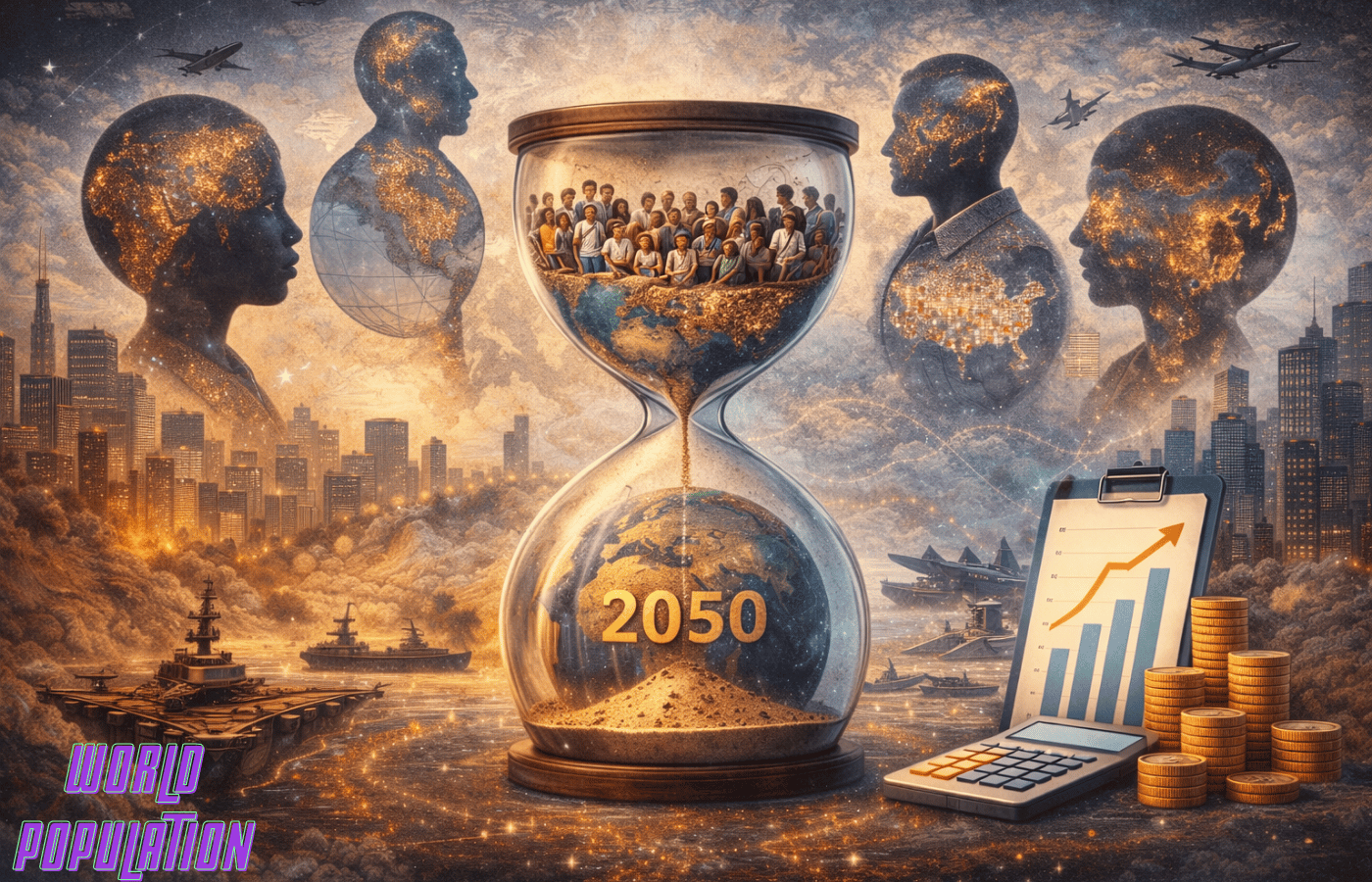
Demography and Power Balances
How Today’s Population Is Shaping the World of 2050
Demography is often a slow-moving force, yet its impact is remarkably deep. When trying to understand today’s political, economic, and military balances, most analyses focus on defense spending, technological capacity, or energy resources. In my view, however, the truly decisive factor is a quieter but far more persistent one: population structure. If current trends continue and no major corrective action is taken, the global power map in 2050 will look significantly different from today’s.
The demographic data we have today show that this transformation is no longer merely a projection; it is largely predictable. According to the United Nations Population Division and OECD forecasts, the world’s population will continue to grow, but this growth will be highly asymmetric. While some societies age rapidly, others will stand out with young and expanding populations. This imbalance will affect everything from consumption and defense to technology and migration.
The Global Demographic Landscape on the Road to 2050
Current projections suggest that the global population will reach approximately 9.7 billion by 2050. The critical issue, however, is not the total number, but where this population will be located, what age structures it will have, and how productive it will be. Today, much of global consumption growth is driven by countries with younger populations. If this trend persists, economic gravity will inevitably shift toward these regions.
Looking at current data, I believe demographic advantage will be at least as decisive as technology over the next 25 years. Yet if mismanaged, this advantage can easily turn into a significant burden.
Europe: An Aging Power with Declining Flexibility
In the 2050 scenario, Europe’s primary challenge will be population decline and rapid aging. Eurostat projections indicate that while the EU’s total population will not grow significantly by 2050, the share of people aged 65 and over will approach 30 percent. As the working-age population shrinks, pressure on social security systems will intensify.
This situation will push Europe to rely more heavily on technology. Automation, artificial intelligence, and productivity gains will be deployed aggressively to compensate for labor shortages. However, this is where my skepticism begins. Technology can accelerate production, but it cannot sustain consumption and economic dynamism on its own. Without a systematic and selective migration policy, Europe may find itself retreating into a more defensive position in the global power competition.
The United States: Demographic Balance Through Immigration
The United States stands in a relatively advantageous position. Even as fertility rates decline, it remains one of the few advanced economies capable of renewing its population through immigration. According to U.S. Census Bureau data, the country’s population is expected to reach around 375 million by 2050.
The decisive factor here is integration. If the U.S. continues to attract and successfully integrate young, skilled migrants, it can convert its demographic position into sustained economic and technological leadership. Otherwise, a European-style aging risk may also become relevant for the United States in the medium term.
China: From Abundance to Scarcity
China’s 2050 outlook is perhaps one of the most striking. A population that once provided an almost unlimited labor advantage is now aging rapidly. According to UN data, China’s population will begin to shrink after 2030 and is expected to be nearly 100 million smaller in 2050 than it is today.
This shift will force China to invest even more heavily in technology. Robotics, automation, and artificial intelligence will become essential tools to replace a shrinking workforce. However, population decline will also suppress domestic consumption, creating a structural challenge for China’s growth model.
India and Africa: Demographic Opportunity or Risk?
By 2050, India is expected to become the world’s most populous country, with a population approaching 1.6 billion. Africa, meanwhile, will account for more than half of global population growth. In theory, the young populations of these regions represent a major opportunity.
The critical question, however, is whether this population can be made productive. Without sufficient investment in education, healthcare, and employment, demographic advantage may turn into social and political instability. In my view, the future of both India and Africa depends heavily on the structural decisions taken over the next two decades.
Türkiye: Can the Demographic Window Reopen?
For Türkiye, the picture is more delicate. Data from TURKSTAT and the United Nations show that fertility rates have fallen below the replacement level. If this trend continues, Türkiye will also join the group of aging societies in the medium term.
At this point, my personal view is clear: increasing population growth is not merely a social issue for Türkiye, but a strategic one. If internal dynamics are insufficient, integrating labor from regions with strong cultural and historical ties—such as Central Asia or communities of East Turkestan origin—should be seriously considered. This would not mean uncontrolled migration, but rather a planned, selective, and productivity-oriented workforce strategy.
In the 2050 scenario, power will not depend solely on producing technology, but on having the human capital capable of using, consuming, and improving it.
Demography often remains in the background amid rapidly changing agendas. Yet from today’s perspective, the power balances of 2050 are already largely written. The real question is who will read this picture correctly and take action in time.