
Analytical Thinking and Innovation
As you know, the World Economic Forum (WEF) is an independent international organization aimed at shaping global, regional, and industry agendas by bringing together leaders from business, government, academia, and civil society worldwide.
In line with its mission, it encourages leaders from various sectors and countries to convene, discuss critical global challenges, and collaborate to develop solutions. As a result of the initiatives it organizes under various headings, it shares critical, annually updated studies with the public; we can list a few as examples:
Global Competitiveness Report: Evaluates the economic competitiveness of countries.
Global Risks Report: Analyzes global risks and provides guidance on managing these risks.
Future of Jobs Report: Examines changes in the labor market and future skill requirements.
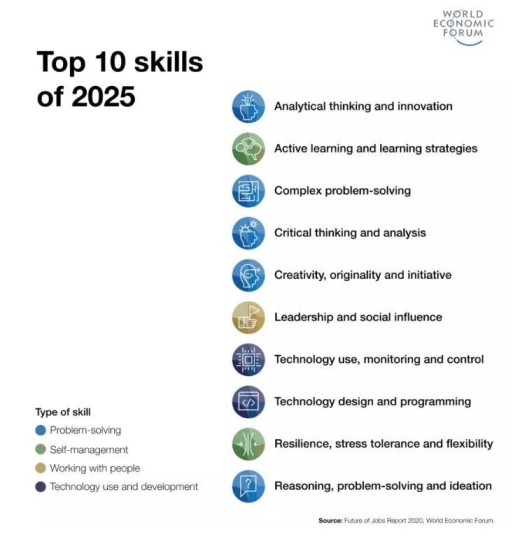
The title "Top 10 Skills of the Future," featured in the World Economic Forum's report published in 2020 covering a five-year projection, highlights the skills that have become essential for success in the business world by 2025. Grouped under four main categories, these skills play a critical role in enabling individuals and organizations to succeed. In this blog series, we will examine these skills one by one, focusing on how we should design ourselves to be prepared for the future.
- Analytical Thinking and Innovation. What is it?
Analytical thinking is the ability to solve complex problems in a logical and systematic manner. Analyzing data, organizing information, and drawing meaningful conclusions from this information are core elements of analytical thinking. In Peter Facione's work titled "Critical Thinking: What It Is and Why It Counts," analytical thinking is defined as "the set of mental processes used in solving problems by gathering data, analyzing it, and drawing logical conclusions from it."
Innovation, on the other hand, is the process of developing new ideas, products, services, or processes to improve existing situations. This skill is a combination of creative thinking and problem-solving abilities. In Clayton Christensen's book "The Innovator's Dilemma," innovation is defined as "the process of transforming creative ideas into economic or social value."
Why Might They Have Started with This Topic as the First Skill?
Several reasons can be put forward to understand why the World Economic Forum placed the "Analytical Thinking and Innovation" skill at the top of the list. The problems we face in today's world are becoming increasingly complex. Large-scale challenges such as global warming, pandemics, and rapid technological changes require individuals with analytical thinking capabilities. This skill is the process of breaking down complex problems into their components to make them more manageable and to generate solutions.
Furthermore, analytical thinking and innovation carry immense importance for securing a competitive advantage in the business world. Companies that effectively analyze data and develop innovative solutions can adapt to market conditions more rapidly and stay ahead of their competitors. For example, Amazon's use of big data analytics to predict customer preferences and personalize its services accordingly has reinforced the company's industry leadership.
How Can We Develop Ourselves?
Several strategies can be followed to develop analytical thinking and innovation skills. First, taking trainings and courses focusing on data analysis and problem-solving techniques is important. Online platforms offer a wide range of resources in this regard. For instance, on platforms like Coursera and edX, you can find many courses on data science and analytical thinking.
Second, engaging in activities that encourage creativity is also beneficial. Activities such as brainstorming sessions, innovation workshops, and creative writing can help improve your innovative mindset. These types of activities allow you to gain different perspectives and enhance your ability to produce creative solutions.
Finally, drawing inspiration from successful examples is key. For instance, Tesla has revolutionized the automotive sector by making innovations in electric vehicle technology and utilizing analytical thinking capabilities in the development of these vehicles. Similarly, Google's continuous improvement of its search engine algorithms using data analysis is a great example of how analytical thinking can make a difference in the business world.
In the first part of this blog series, we briefly addressed the skill of "Analytical Thinking and Innovation." While analytical thinking requires a logical and systematic approach to solving complex problems, innovation means developing new ideas, products, and processes. The combination of these two skills is the key to success in the future. In our future posts, we will examine other skills included in the World Economic Forum's list. Stay tuned!