New Year Opportunities
New Year and New Beginnings…
As is well known, the New Year is not merely a symbolic threshold; it is a period that produces extremely concrete results in terms of the economy, business life, and individual expectations. New Year expectations, far beyond a calendar change, are a modern reflection of the need for people and institutions to divide and make sense of time. The roots of this need are ancient, while its effects today are more measurable than ever.
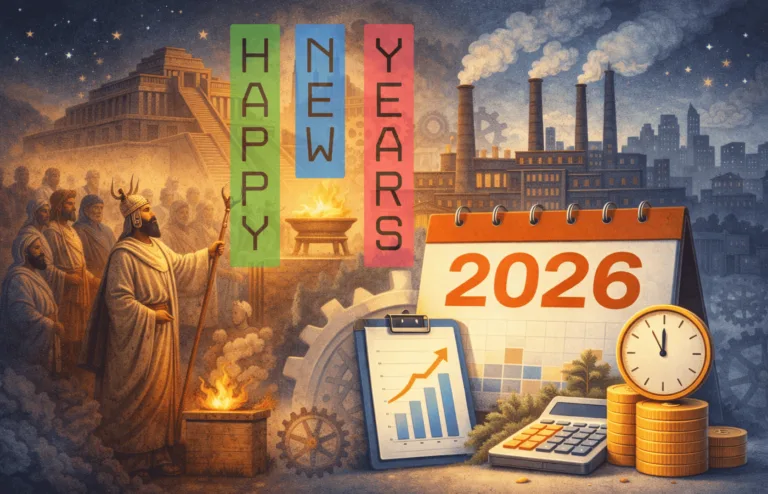
In ancient societies, the new year was associated with agricultural cycles and taxation calendars. In Mesopotamia, the Akitu Festival, and in Rome, the financial and administrative start of the year coincided with this period. Thus, historically, every new year has always been a moment of accounting and starting anew. What has changed today is the scale of this accounting.
New Year and Economy: What Do the Numbers Say?
In the modern economy, the New Year and Christmas period is a critical timeframe where consumption concentrates. According to OECD and Eurostat data, approximately 25–30% of retail sales in developed economies occur in the last quarter of the year. In the US, this rate reaches up to 35% in some sectors. This is not only about individual spending; companies' inventory, logistics, and cash flow planning are also shaped according to this period.
2023–2024 data shows that consumer spending in the European Union was approximately 18% higher in the last quarter of the year. In China, depending on the Spring Festival calendar, a similar economic concentration shifts to the first quarter of the year. The calendar differs, but the reflex is the same: seasonal concentration.
These numbers make me think: New Year opportunities are not an artificial expectation created by the market, but a measurable pattern of economic behavior.
When Did the New Year Culture Take Root in Corporate Life?
The origins of the New Year reflex in the corporate world trace back to the Industrial Revolution. As mass production, budgeting, and performance management spread, the need to set annual targets emerged. From the middle of the 20th century onwards, almost all budget cycles in large companies were tied to annual periods.
Today, more than 90% of Fortune 500 companies use an annual strategic planning and performance evaluation cycle. The reason for this is not a romantic idea of a "new start"; it is the ease of measurement. It becomes difficult to make comparisons without distinct periods. Therefore, the New Year is more of a management tool than a motivational tool in corporate life.
Why Do We Enter an Expectation of a New Start?
This is where psychology comes into play. Behavioral economics literature shows that people make bolder decisions at time thresholds called "temporal landmarks." Periods such as New Year's Day, birthdays, or starting a new job create a sense of mental reset.
A behavioral economics study published in 2024 reveals that over 60% of individuals revise their financial goals at the beginning of the year. Only 23% of the same people update these goals in the middle of the year. This means the New Year is not irrational; it is a mentally powerful trigger.
Counterarguments: Does the Calendar Change, or the Behavior?
Of course, there are critics of this approach. Those who say "life doesn’t change just because the calendar changes" are not wrong. There is a strong view arguing that targets remain meaningless without a change in behavior. However, from my perspective, this understates the power of symbols.
The calendar alone is not a solution; but it provides a framework for a start. New Year opportunities are not a promise of miracles; they are an opportunity for orientation. When we miss this distinction, we either enter excessive expectations or declare the whole concept meaningless.
US, China, and Europe: Same Concept, Different Interpretations
In the US, the New Year is framed around individual goals and consumption. From the perspective of financial markets, the turn of the year marks a portfolio rebalancing period. In China, on the other hand, the new year effect depends on the Lunar Calendar; a short but sharp pause is experienced in production and logistics activities. In Europe, Christmas and the new year are handled together; end-of-year accounting stands out as much as the increase in consumption.
The common point of these three approaches is this: The New Year is a cultural way of coping with uncertainty.
As we approach 2026, it is necessary to address the concept of New Year opportunities without exaggerating it, but also without underestimating it. The new year doesn't change everything; but it determines the direction. The more consciously this direction is drawn in the economy, business life, and individual decisions, the more productive the year will be.
I wish 2026 to be a year in which more realistic goals are set, measuring and learning come to the forefront, and expectations are balanced with discipline. The new year may not be magical; but when used correctly, it is powerful.