
Data Centers and Energy Consumption
The Rising Share of Digital Infrastructure in Energy Consumption
With the widespread adoption of digitalization and artificial intelligence applications, the energy demanded by data centers is showing a remarkable increase on a global scale. According to data from the 2023–2024 period, data centers worldwide account for approximately 1% – 2% of total electricity consumption. This energy consumption will show a significant increase over the next 5–10 years due to cloud services, large language models, and continuous data flow.
Behind this lies massive server farms, high-performance processors, and the need for continuous uptime. For example, a large hyperscale data center can draw up to 100–200 MW of power. This value is comparable to the energy needs of a small town. Cooling systems also constitute a significant portion of this consumption; because powerful air conditioning and cooling infrastructure are required to prevent servers from overheating.
This high energy demand creates immense pressure on global energy systems in terms of carbon footprint, energy supply security, and sustainability. Renewable energy alone is not always sufficient: since solar and wind energy are intermittent, seasonal, and grid-dependent, data centers require uninterrupted and stable power.
Private Nuclear Power Plants and Small Modular Reactors (SMRs): Plans and Challenges
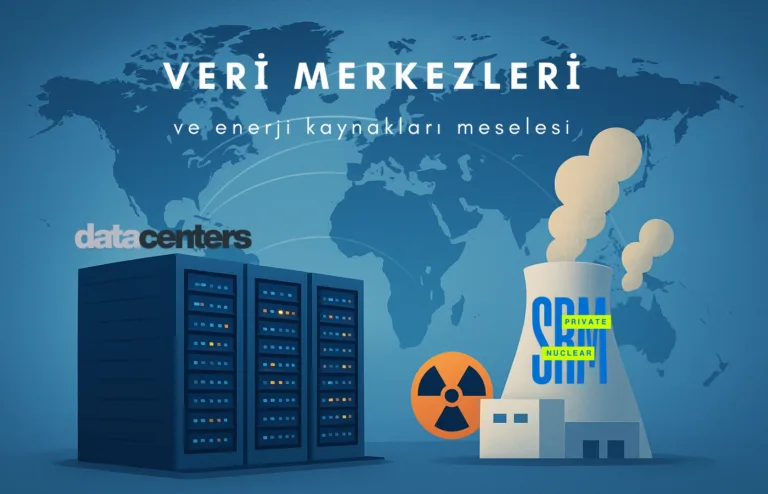
In an environment where energy needs are so high, some technology companies and energy investors are considering securing their own energy supply through small modular nuclear reactors (SMRs) or private nuclear power plants.
SMRs are a type of reactor that is smaller in scale than traditional large nuclear power plants, requires less capital and land, and offers modular installation options. This technology is theoretically seen as suitable, especially for facilities that continuously consume high amounts of energy like data centers. Its advantages include: high and stable power generation; carbon emissions being much lower compared to fossil fuels; and reducing grid dependency.
However, putting these plans into practice is not easy. Regulatory approvals required for SMR construction, high initial investment costs, nuclear waste management, public acceptance, and security concerns are major obstacles. Furthermore, the cost of nuclear energy production is debatable when compared to a combination of renewables and energy efficiency enhancement projects.
Today, there are still no widespread concrete examples of the private sector building and operating its own nuclear power plants. This demonstrates that there are serious barriers to translating theory into practical reality. However, we know that almost all of the 7 big companies we call the Magnificent Seven have major data center investments, and beyond viewing SMRs favorably, they are making initiatives and conducting intense contacts, primarily in America, for necessary permits. Of course, while SMRs are technically an option, my view is that claiming they are "the solution to everything" just yet would be an exaggeration.
International Competition: Countries' Data Center Attraction Strategy and Security Concerns
Particularly in Europe, North America, and Asia, some states are offering attractive packages such as tax incentives, energy infrastructure support, and permit facilities to draw data centers within their borders. The underlying motivations behind this approach vary: digital economy investment, job creation, technological independence, attracting investors, and strategically, data sovereignty.
In fact, there are even countries offering very generous incentives, thinking: "If I move the data centers of all these tech giants to my country, no one will dare to wage war against my country." – Frankly, this is an idea that seems both very absurd and very logical when compared to extremely high defense industry expenditures to protect a country. –
Some governments view these centers as a "security shield." Because today, data and digital infrastructure are intertwined with critical fields such as defense, communication, finance, and healthcare. If this infrastructure is under the control of foreign companies, a risk perception can arise regarding national security and sovereignty. Therefore, having localized data centers is important for some countries, both economically and strategically.
However, when evaluating this strategy, it is not just "geographical attraction" that comes into play, but also complex components such as energy sources, environmental impacts, infrastructure adequacy, regulation, and oversight capacity. Simply drawing centers to one's own country may fall short of solving the problem if the infrastructure is not sustainable or the energy source is not secure.
Economic Impacts and Long-Term Risks
The methods data centers use to meet their energy needs affect investment costs and operational expenses in the short term — for both companies and states. If energy costs are high, the price of data services may rise; this could affect access to digital services and competitiveness.
Alternatives like SMRs or nuclear energy can stabilize energy costs in the long term; however, they require high initial investment, regulatory processes, and public acceptance. In many countries, policies regarding nuclear energy progress slowly due to public pressure, safety, and waste issues. This makes it difficult for private sector projects to be implemented. Speaking of which, let us also address a topic currently on Turkey's active agenda. Turkey is currently seriously considering whether SMRs could be a prescription for energy external dependency. In fact, it is keeping the issue of supplying 50,000 MW of power by the year 2050 from TERRAPOWER, an initiative backed by Bill Gates, on the table.
Yes, increasing state-supported data center investments can boost competition — which is positive. However, if these investments are made unprepared in terms of energy infrastructure and regulation, unexpected problems could arise environmentally, socially, and economically.
A Balanced, Transparent, and Long-Term Path Forward
My view is that the safest path for the energy of data center infrastructure and AI-based digital infrastructure is not a single technology, but a mixed and balanced energy strategy. Renewable energy should be utilized as much as possible; energy efficiency must be increased; and when necessary, alternatives like nuclear energy should be evaluated — but only with strict regulations and transparency.
At the same time, when geographically positioning data centers, not only economic incentives but also energy supply security, environmental sustainability, regulatory infrastructure, and public safety should be taken into account. States viewing these centers as a "security shield" may be a strategic vision; but the long-term risks and responsibilities of this vision must also be visible.
The stronger the balance established between data, digital infrastructure, and energy — the three fundamental pillars of the new digital economy — the more sustainable, fair, and democratic the digital age can remain.
🔗 Sources & Further Reading (Link List)
“How much energy do data centres actually consume?”, Nature, 2023 — analysis on the share of electricity consumption of data centers worldwide
“Data Centers, Energy Use, and Environmental Impact” — International Energy Agency (IEA) 2024 report
“Small Modular Reactors (SMRs) — A potential path for data center power?” — Energy & Nuclear Policies Forum, 2024
“European Digital Infrastructure Strategy and Data Centre Location Incentives” — European Commission, 2024 declaration
“National Security and Data Sovereignty: Why Countries Want Local Data Centers” — Global Policy Journal, 2023