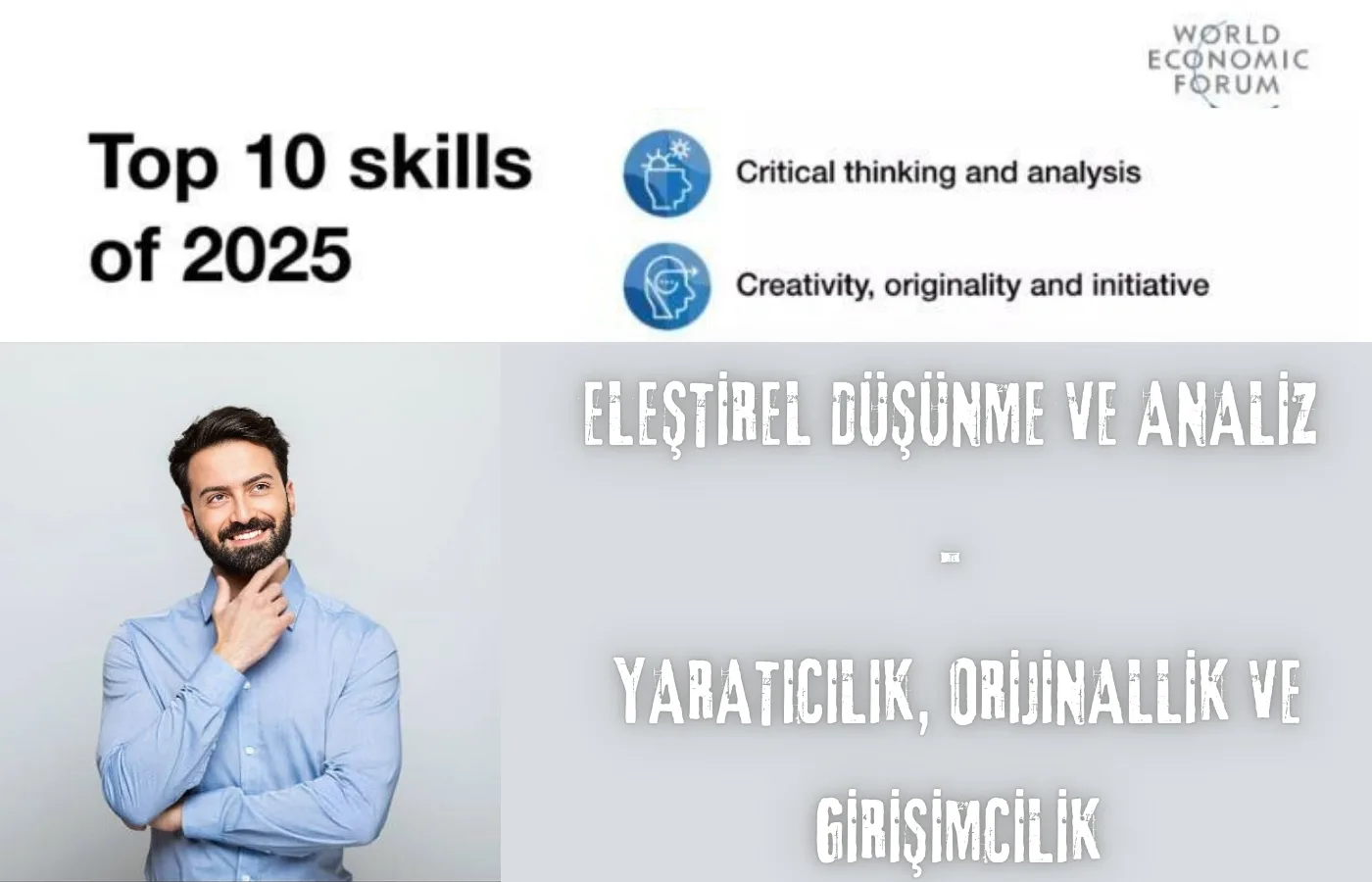
"Critical Thinking and Analysis" and "Creativity, Originality, and Entrepreneurship"
We are continuing our article series on the "Top Ten Skills of 2025," and this time, the competencies we will discuss are "Critical Thinking and Analysis" alongside "Creativity, Originality, and Entrepreneurship." Why are these skills so vital? How can we develop them? And where do they serve us best? Let's dive in and break it all down together.
Why is Critical Thinking and Analysis Important?
Critical thinking is the capability to make evidence-based, logical, and well-reasoned decisions. According to the World Economic Forum (WEF), this competency stands out as one of the most essential skills needed to navigate an increasingly complex global landscape. In an era dominated by information overload and rapid digital transformation, being able to evaluate data objectively, separate facts from noise, and identify underlying patterns is no longer optional—it is a core necessity for strategic problem-solving.
Developing Critical Thinking and Analysis
Cultivating analytical skills requires intentional practice. Questioning assumptions, seeking out diverse perspectives, and breaking down complex problems into manageable components are effective strategies. Engaging in structured logic exercises, conducting root-cause analyses, and continuously testing one's own biases significantly sharpen critical evaluation capabilities over time.
The Power of Creativity, Originality, and Entrepreneurship
While critical thinking enables us to evaluate existing frameworks, creativity, originality, and entrepreneurship empower us to construct entirely new ones. Automation and AI are rapidly taking over routine cognitive tasks; however, the ability to generate novel ideas, connect seemingly unrelated concepts, and convert innovative vision into actionable value remains uniquely human. Entrepreneurial thinking involves calculated risk-taking, resilience, and an unwavering drive to challenge the status quo.
Where Do These Skills Apply?
These combined skill sets apply across every modern professional domain—from technological innovation and corporate leadership to crisis management and social entrepreneurship. Professionals who balance sharp analytical rigor with original creative vision are uniquely positioned to navigate disruption, lead high-performing teams, and build sustainable solutions for the future.
Sources:
- World Economic Forum (WEF): Future of Jobs Report on core workforce skills and cognitive competencies.
- Source: World Economic Forum. Future of Jobs Report.